Credit Repair Company vs. FCRA Attorney: What’s the Difference?
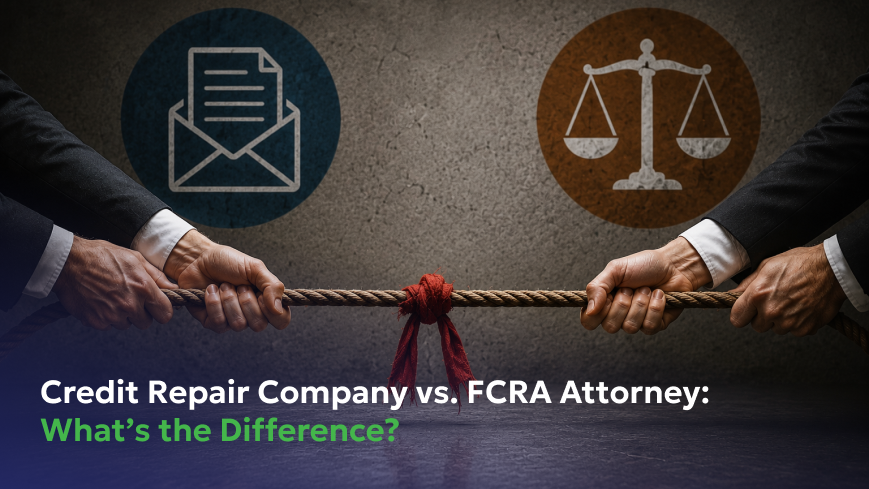
If you’re dealing with a credit problem, it’s natural to search for a credit repair company or a credit fix attorney and expect to find someone who can truly help. The problem is that those terms cover two very different types of services, and knowing which one you actually need makes a big difference in what happens next. One is a paid service that disputes items on your behalf (credit repair service). The other is a legal practice that pursues claims under federal law when your rights have been violated (FCRA attorney). This page explains how the two work, where they overlap, and where they don’t.
The confusion about these two types of service is likely worsened by the fact that some people search for help by looking for a credit repair law firm. While this sounds like the same thing as a paid credit repair company, it is not. As long as you’re working with a law firm, you’re in the legal practice realm, not the paid service realm. A credit repair law firm is the same thing as an FCRA attorney or credit report lawyer.
What Does a Credit Repair Company Do?
Credit repair companies, including ones that market themselves as credit repair legal services providers, typically offer a subscription or flat-fee service. You pay a monthly fee, and they send dispute letters to the credit bureaus on your behalf. The goal is usually to get inaccurate negative items removed from your report, which in turn raises your credit score.
Some of these companies are legitimate and operate within the law. They can be useful for people who don’t want to handle the dispute process themselves and are dealing with relatively straightforward issues. Others, however, make promises they cannot deliver on, like guaranteeing a specific score increase or claiming they can remove accurate negative information. These kinds of guarantees should be a red flag because a credit bureau does not remove information that is accurate whether or not the information is negative.
Credit repair companies are regulated under the Credit Repair Organizations Act (CROA), which requires them to provide written contracts, prohibits upfront fees before services are performed, and gives consumers the right to cancel within three days. The work they do is fundamentally administrative: they dispute items, follow up, and report back.
What Does an FCRA Attorney Do?
An FCRA attorney handles the entire recovery, not just the process of disputing inaccurate negative items on your credit reports. An FCRA lawyer does also take care of the dispute process, but then evaluates whether a consumer reporting agency (like a credit bureau, background check company, or tenant screening company) or a data furnisher (like a bank, credit card company, and collection agency) violated federal law, and if so, pursues legal claims on your behalf (i.e. files a lawsuit).
The Fair Credit Reporting Act (FCRA) requires consumer reporting agencies to follow reasonable procedures to ensure maximum possible accuracy, conduct genuine reinvestigations when consumers dispute errors, and correct information that cannot be verified. (Furnishers have their own obligations to investigate and correct inaccurate data.) When these requirements aren’t met, the FCRA gives consumers the right to sue.
The legal work done by an FCRA attorney involves:
- reviewing your full credit reports
- analyzing your dispute history or preparing an initial dispute
- advising you on the optimal supporting documentation and evidence
- identifying who’s responsible for the violation
- filing a lawsuit if the facts support a claim
- pursuing corrections and compensation if you’ve been harmed by the error
If the case is successful, the FCRA requires the violating party to pay your attorney fees, which is why most FCRA attorneys, including Consumer Attorneys, handle these cases at no out-of-pocket cost to the client.
Key Differences Between Credit Repair and FCRA Litigation
The distinction comes down to what each of them does, what it costs, and what it can accomplish.
A credit repair company sends disputes on your behalf and charges you for it, usually on a monthly basis. They work within the existing dispute process, and their leverage is limited to what this process allows. If the credit bureau verifies the item, concludes it’s accurate, and leaves it on your report, that’s it – the credit repair company doesn’t have a legal mechanism to push further. They can re-dispute, but they cannot file a lawsuit or recover compensation for the harm the error caused. They simply work within the loop of filing repeated disputes over the same information.
An FCRA attorney can step in at any stage, whether you’ve just discovered the error, you’re about to file an initial dispute, you’re in the middle of an active dispute, or you’ve already been through the dispute process with no resolution. Their role is to evaluate whether a violation of federal law has occurred and, if it has, to pursue legal claims on your behalf.
The attorney isn’t charging you monthly fees to send letters. They’re evaluating whether you have a legal claim, and if you do, they pursue it in court. The cost structure is different from credit repair companies, too:
- Credit repair is a service you pay for, whether it works or not.
- FCRA litigation costs you nothing out of pocket because the law shifts attorney fees to the defendant if the case succeeds.
There is also a difference in what the outcome can look like. Credit repair, at best, gets a negative item removed. FCRA litigation can result in correction of the error, financial compensation for the harm it caused, and, in some cases, statutory or punitive damages.
Credit Repair Lawyer for Serious Credit Report Errors
Consumer Attorneys is not a credit repair company. We don’t send templated dispute letters for a monthly fee or promise to raise your credit score by a certain number of points. That is a different business.
We handle credit report errors by enforcing the law and pursuing real recovery. When inaccurate, false, mixed, outdated, or fraudulent information appears on a credit report and causes harm, this is where our work begins. Whether you have already been through the dispute process or are just discovering the problem, we can evaluate the situation and determine what legal options are available.
If you have been searching for a credit repair lawyer or an attorney to fix credit because something on your report is genuinely wrong, what you may need is legal representation, not a credit repair subscription.
The difference matters. A company working in the credit repair model will keep disputing. An FCRA attorney or credit fix lawyer will assess whether the failure to correct the error is itself a violation of the law and pursue it accordingly.
When Should You Talk to an FCRA Attorney?
You can talk to an FCRA attorney as soon as you discover an error on your credit report, or at any point after, even if you’ve already filed unsuccessful disputes. Here are some real world examples of when an FCRA attorney can step in:
- If you have already disputed an error and the credit bureau came back with "verified" and didn’t make any correction, this is a sign the dispute process has run its course.
- If the error caused you a real loss- like a denied loan, a housing rejection, or a job that didn’t come through- a credit repair company cannot recover damages for you, but an FCRA attorney can.
- If someone else's information is in your file and the credit bureau is not separating the records, a subscription dispute service is not equipped to deal with this scenario, but an attorney is.
- If a furnisher is knowingly reporting information that it has been told is wrong, this is a legal problem that a lawyer can help with.
In these situations, you are past the point where throwing dispute letters at the credit bureaus can help. You need someone who can evaluate whether your rights were violated and take it from there.
How Consumer Attorneys Can Help
If you have a credit report error that hasn’t been corrected through the dispute process, or if the error has already caused financial, professional, or personal harm, Consumer Attorneys can review your situation. This includes looking at the error itself, your dispute history, the bureau's response, and any documentation of the harm to assess whether an FCRA violation occurred.
There are no out-of-pocket fees; you pay nothing for our work. If the case is successful, attorney fees are recovered from the defendant under the FCRA's fee-shifting provisions.
If you have already disputed the error and the credit bureau didn’t fix it, speak with a credit report error lawyer.
Learn more about your legal rights under the Fair Credit Reporting Act from our FCRA attorney page.







Daniel Cohen is the Founder of Consumer Attorneys. Daniel manages the firm’s branding, marketing, client intake and business development efforts. Since 2017, he is a member of the National Association of Consumer Advocates and the National Consumer Law Center. Mr. Cohen is a nationally-recognized practitioner of consumer protection law. He has a we... Read more
Related Articles


R
ONGS™