Employment Background Check Errors Lawyer: How You Fix Inaccurate Hiring Reports
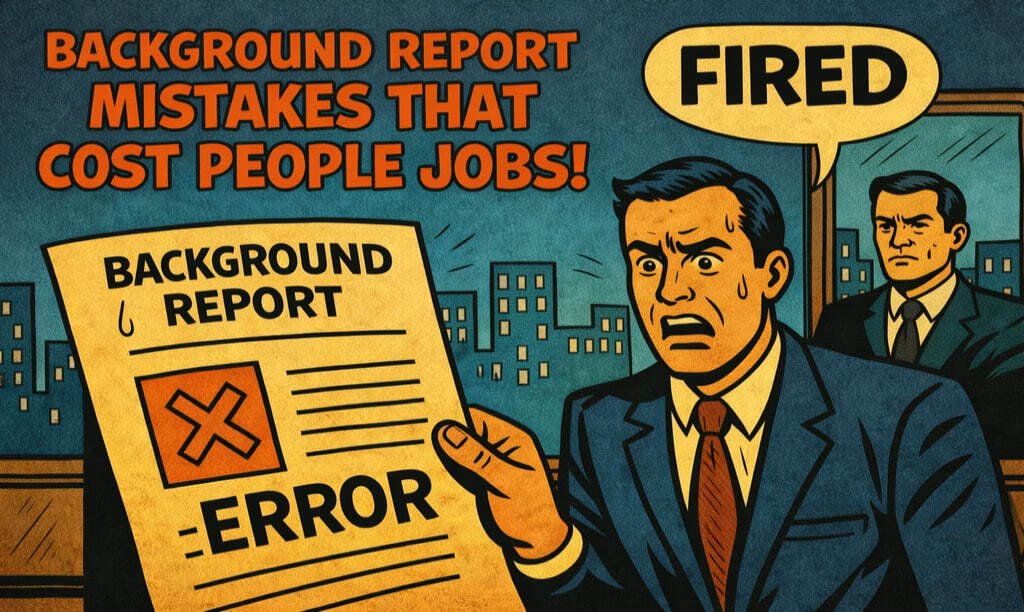
An inaccurate employment background check can quickly put a job offer at risk, especially when the report contains records that were mismatched, outdated, or never carefully reviewed. Most people don’t even see it coming. The offer comes through, the start date gets set, and then the recruiter calls back with a different tone, and the conversation is over because of something on a report nobody looked at twice.
The phrase that comes up over and over in our intake calls is “my background check is wrong.” Sometimes the report shows charges that were dismissed years ago. Sometimes it shows criminal history that belongs to someone with the same first and last name. Sometimes the motor vehicle section says “convicted” when the actual court record says “not guilty.” These are not edge cases. They are the everyday material of FCRA litigation against screening companies.
The System is the Problem
These errors are rarely one-off accidents or once-in-a-while technical glitches. Instead they’re regular occurrences that result from a broken reporting system that big data companies don’t seem willing to fix. Screening companies rely on automation rather than human review. They pull from databases that are months or years out of date. And they match records on name and date of birth alone. And the end result is errors like dismissed charges showing up as active, someone else’s record getting attached to your name, and old arrests resurfacing long after they should have dropped off.
At our law firm, we've seen the consequences of these reporting practices firsthand. Consumers come to us after losing job opportunities because dismissed charges were reported as active, someone else's criminal history was attached to their file, or outdated arrests continued appearing long after they should have been updated or removed. These are the kinds of errors that can have real consequences for qualified applicants trying to move forward with their careers.
You Rights Under the FCRA
The Fair Credit Reporting Act, 15 U.S.C. § 1681 et seq., was written to stop exactly these kinds of sloppy reporting procedures. Under the Fair Credit Reporting Act (FCRA), background check companies are required to use 'reasonable procedures to assure maximum possible accuracy.” This means you have a legal right to an accurate employment background check report.
When your employment background check contains errors, especially when those errors block you from a job, speaking with a background check lawyer can help you understand:
- the data streams in your report, including where they came from and why they’re wrong
- whether your rights under the FCRA were violated
- what your legal options are, including whether you’re likely entitled to compensation for background check errors that cost you the job.
Keep reading to find out all about employment background check errors, when a bad report becomes a legal case, and how you can take matters into your own hands and solve this problem once and for all by working with an experienced background check attorney.
Inaccurate or Incorrect Background Check Information
An inaccurate background check is any report that gets the facts wrong, whether the information is outdated, mismatched, duplicated, inaccurate, or attached to the wrong person entirely.
Federal law, under the Fair Credit Reporting Act (FCRA) requires consumer reporting agencies to produce accurate data during employment background checks. This standard sounds straightforward on paper, and yet errors keep showing up.
And, what most people discover the hard way is that even one piece of incorrect information on a background check can be enough to lose a job offer entirely at the outset or get deactivated from a job you already have.
When inaccurate background checks land in front of an employer, it is the applicant who carries the entire weight of the mistake. Hiring decisions get made fast, often before anyone reads past the headline of the report, and the applicant is left chasing down what went wrong while the position moves on without them.
Common Background Check Mistakes
Most background check mistakes trace back to the same handful of root causes: mismatched files, stale court records, and dispositions that were never updated. A name plus a date of birth is still all it takes for many automated systems to pair a record with an applicant. Casting the net wide and loose is why mistakes in background check reports keep happening, even after years of FCRA litigation putting screening companies on notice.
What does an incorrect background check actually look like in practice? Here are common examples of background check mistakes:
- Criminal records belonging to a stranger with a similar name.
- Dismissed charges listed as still pending.
- Misdemeanors written up as felonies.
- Old arrests that never led to a conviction sitting at the top of the report years later.
- Duplicate records that include the same charge listed two or three times so that a criminal history looks longer than it actually is.
- Sealed or expunged records that were legally cleared getting reported anyway.
- Motor vehicle entries that misstate convictions, traffic violations, and driver’s license status.
For a fuller breakdown of what goes wrong and why, see our guide on common background check errors.
Background Check Companies That Prepare These Reports
Most employers don’t actually run background checks themselves. They hand the work off to a consumer reporting agency (aka background check company), which pulls from court databases, public records, and commercial data feeds to create your report.
The employer receives a report summarizing the information about you, and you rarely see anything at all unless something gets flagged.
Many background check companies, including Checkr, HireRight, First Advantage, Sterling, Accurate Background, and Asurint, rely on automated systems to match records. This process can result in inaccurate or misleading reports. Each company has its own dispute process, its own data vendors, and its own track record in federal court when these processes break down.
Failed a Background Check After a Job Offer?
If you failed a background check after a job offer, the law gives you a window before the employer can take that offer back. Under 15 U.S.C. § 1681b(b)(3), the employer has to send a pre-adverse action notice first, along with a copy of the report and a written summary of your FCRA rights. Only after a reasonable period can the offer be officially withdrawn.
This window after a conditional offer is short, and what happens during this window matters later. To maximize your potential of protecting yourself, we recommend that you:
- Get a copy of your employment background check report in writing
- Ask the employer which specific information in your background check report lead to the pre-adverse action notice.
- Notify the employer if any of the information in your report is inaccurate or wrong
- Save every email with the employer or any other relevant party
- Document each call or interaction with the screening company
These records become the backbone of any claim that follows. Getting early legal help after a failed background check is what often makes the difference between just losing the position quietly versus fixing the mistakes and recovering compensation down the road.
A common question we get asked is, “Can I sue an employer for not giving me the job due to errors?” While there are some exceptions that have to do with an employer mishandling data, for the most part the answer is no. The employer typically has a legal right to make a decision based on the information that is provided in the background check report. If this info is wrong, the background check company is who you may have to file a lawsuit against.
Disputing a Background Check Error and Why It May Not Be Enough
Under the Fair Credit Reporting Act (FCRA), you have the right to dispute inaccurate employment background check data and the consumer reporting agency has to conduct a reasonable reinvestigation based on your dispute. In other words, once you dispute incorrect background check information, the screening company has to reinvestigate the disputed info and either verify it or correct it, typically within 30 days.
These employee background check error disputes can also be used to force reporting companies to clean up the smaller stuff too, like a stray outdated entry. Basically, if you find an error, you should dispute it, whether it’s big or small.
How to Dispute An Employment Background Check
The right way to dispute background check report entries is in writing, item by item, with supporting documents like certified court dispositions or identity records attached.
For a step-by-step walkthrough of the process, see how to dispute a failed background check. When the dispute does not fix what is broken, the FCRA gives the consumer the right to take the next step.
Why a Dispute May Not Be Enough
The deeper problems, like mixed files in particular, tend to come back. We see these data errors re-reported the very next time the report is run, and sometimes on the one after that. An employment background check error dispute that closes with no real change is one of the most common patterns in this entire area of law.
How to Fix an Inaccurate Background Check in 5 Steps
The first step in how to fix an inaccurate background check is getting a copy of the actual report. Don’t rely on a self-pull from a free site. Request a copy of the report the screening company sent to the employer. This is the version that matters legally, and it is the only one that shows what the employer actually saw.
Fixing background check error entries means writing a well-drafted dispute letter that names each incorrect item and includes the records that prove the mistake: certified court dispositions, expungement orders, a DMV abstract, ID documents, whatever is needed to back up your claim. Keep copies of everything.
We recommend mailing the dispute and supporting documents via certified mail, return receipt requested. When you mail everything and save the proof, you’re in control of confirming the timeline and proving the dispute was received, not them. Also, some online dispute platforms provided by background check companies require you to waive your legal rights in order to file “conveniently” online. Waiving your legal rights is never convenient for you, only for them.
The background check company then has to investigate, contact the original source of the data, and either correct, delete, or verify the disputed information within the timeframes set by the FCRA (typically 30 days). Keep track of the date you mailed it, the date it was received, and the date 30 days has passed without a response.
In many cases, a lawyer is needed as the next step. Some common signs that the problem has stopped being a simple fix and has proven to be a bigger problem which could benefit from legal support include: (a) the screening company keeps reporting the same error after a clean dispute, (b) the job you applied for is already gone or you’ve suffered professional, financial, or reputational harm, or (c) the underlying problem is something structural like a mixed file the company refuses to separate. These signs point to issues involving legal liability under the FCRA, and an experienced background check lawyer can take the matter from dispute to litigation.
When You May Need a Background Check Lawyer
If you’ve taken the steps to attempt a dispute on your own, you still might need to bring in a lawyer for background check errors. A background check attorney reads and reviews the file, including the dispute history and the adverse action paperwork, and gives you legal advice, including recommendations on whether you have grounds to sue a background check company.
The two most likely situations that may require an escalation to a lawsuit include:
- The dispute process has run its course, but the report still gets it wrong. Continuing to report inaccurate background check information after a dispute likely needs legal intervention.
- The damage has often already been done through a withdrawn job offer, a deactivated gig account, or an opportunity that went to someone else. If you've suffered financial, professional, reputational, or emotional harm because of an employment background check error, it's worth speaking with an attorney to understand your legal rights and the options available to you. Depending on the circumstances, you may be able to pursue compensation for the harm you've suffered.
Experienced background check lawyers look at the whole picture: what the report said, what the dispute responses showed, what notices the employer sent or skipped, and what the loss actually cost the consumer in wages, time, and stress.
A successful FCRA claim can include actual damages, statutory damages, punitive damages where the conduct was willful, and attorneys’ fees, which is why a background check attorney can take these cases on contingency at no out-of-pocket cost to the consumer.
Our cases
Wrong Violent Felony Convictions Cost a Truck Driver a Job
In Perez v. LexisNexis Risk Solutions Inc., Consumer Attorneys represents Stephen Aaron Perez, who alleges that an employment background check falsely associated him with numerous serious criminal convictions belonging to other people.
Perez applied for a CDL-A truck driver position with Ryder Integrated Logistics and successfully completed the interview and preliminary screening process. According to the complaint, Ryder offered him the job subject to a routine background check. LexisNexis allegedly supplied criminal-record information to HireRight, which was then used in the employment screening report provided to Ryder.
The report allegedly portrayed Perez as having convictions in Texas for offenses including burglary, robbery, assault involving a family or household member, interference with an emergency call, assault causing impeded breathing, and burglary of vehicles. Perez alleges that he has never been arrested for or convicted of any crime and has never lived in or even visited Texas.
According to the complaint, the records actually belonged to two different individuals—one named Stephen Anthony Perez and another named Jean Carlos Castillo. Their names, dates of birth, Social Security numbers, addresses, and other identifying information differed from Perez’s. The complaint alleges that the inaccurate information prevented him from beginning work with Ryder.
Perez disputed the criminal records and provided identity-verification documents. Although some Texas records were later removed, the complaint alleges that the mixed information was not fully corrected. Perez claims that the error kept him from starting a well-paying job and caused lost wages, lost employment opportunities, reputational harm, and emotional distress.
Court filing: Stephen Aaron Perez v. LexisNexis Risk Solutions Inc., U.S. District Court for the District of New Jersey, Case No. 1:25-cv-18525, filed December 11, 2025.
Another Devin Mendez’s Felony Conviction Appeared on His Employment Background Check
In Mendez v. First Advantage Background Services Corp., Consumer Attorneys represents Devin Mitchel Mendez, who alleges that a felony conviction belonging to another man with a similar name appeared on an employment background check provided to CoreBridge Financial.
Mendez began working as an insurance broker with CoreBridge Financial in September 2025 and had already signed up several clients. His continued employment was conditioned on passing a background check. First Advantage later prepared a criminal background report that allegedly included a felony conviction from Bexar County, Texas.
The complaint alleges that the conviction did not belong to Devin Mitchel Mendez at all. It belonged to an unrelated man named Devin Michael Mendez. The two men had different middle names, different dates of birth, and entirely different Social Security numbers. Mendez alleges that he has never been charged with or convicted of a crime.
After CoreBridge informed him that the background check contained a criminal record, Mendez immediately challenged the information. First Advantage ultimately issued a corrected report, but the complaint alleges that the delay caused Mendez to miss weeks of work and earnings. Because his position was commission-based, he also alleges that he lost clients he had already signed and incurred debt while waiting for the issue to be resolved.
Court filing: Devin Mitchel Mendez v. First Advantage Background Services Corp., U.S. District Court for the Western District of Texas, Case No. 5:26-cv-02115, filed March 30, 2026.

Employment Background Check Errors
Daniel Cohen

Employment Background Check Errors
David Pinkhasov

Employment Background Check Errors
Moshe Boroosan

Employment Background Check Errors
Meir Rubinov

Employment Background Check Errors
Nisan Zaghi

Employment Background Check Errors
Yaear Weintroub

Employment Background Check Errors
Atid Malka

Employment Background Check Errors
Max Warshaw

When my credit report erroneously marked me as deceased, my financial life turned into a nightmare. My attempts to secure loans were hopelessly blocked, access to my existing bank accounts was frozen, and attem...
Frequently Asked Questions
Yes, if the error came from the background check company and it violated the FCRA's accuracy or reinvestigation requirements, the screening company can be held liable for statutory damages, actual damages, and attorneys' fees. The employer can also be liable if they failed to comply with notice obligations under the FCRA.
Under the FCRA, a consumer reporting agency typically has 30 days from the date you file a dispute to reinvestigate and either correct, delete, or verify the disputed information. Extensions may apply in certain circumstances.
Depending on the facts, compensation can include actual damages, statutory damages, punitive damages if the violation was willful, and attorneys' fees.
Repeat reporting of an error you've already disputed and documented is one of the clearest signs of an FCRA violation and a common reason consumers move from a dispute to a lawsuit.
You can file an initial dispute yourself, but if the dispute doesn't fix the problem or you've already lost income because of the error, an attorney can take steps you typically can't take alone, including filing a lawsuit.
Consumer Attorneys handles these cases on contingency, so there are no upfront costs or out-of-pocket fees, and we only get paid if we recover compensation for you.
Related Articles
R
ONGS™