The Consumer Report: A Sequential Analysis of the FCRA Definition
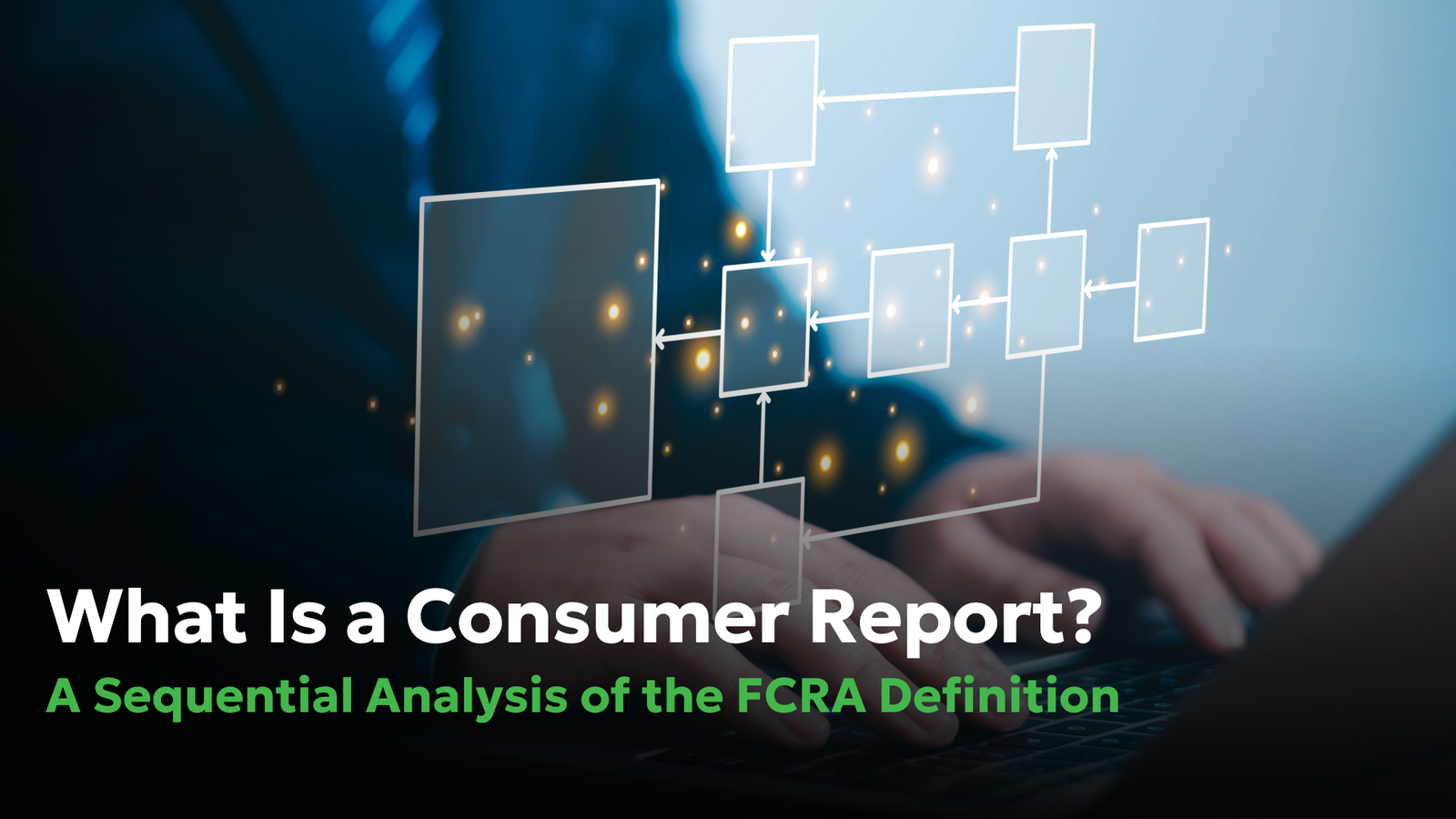
Understanding how the Fair Credit Reporting Act defines a consumer report
The consumer report is the indispensable starting point for invoking the protections of the Fair Credit Reporting Act (FCRA). Whether the Act applies at all hinges on whether a particular communication qualifies as a “consumer report.” That definition is complex and layered, requiring satisfaction of multiple, distinct elements regarding the communication’s form, source, substance, and purpose, as analyzed sequentially from 15 U.S.C. § 1681a(d)(1).
Because these elements interlock and sometimes create circularity, they must be unpacked carefully. What follows is a structured, element-by-element analysis that preserves the statute’s breadth while making sense of its internal logic.
Element 1: Form and Transmission
The statutory definition begins by specifying the form that the information may take. A consumer report is not limited to formal, written documents. Rather, it includes any written, oral, or other communication of information. This broad phrasing ensures that electronic transmissions, digital files, and even verbal discussions can fall within the Act’s scope.
Crucially, the explicit text of the statute does not require that the information actually be transmitted to a third party. This stems in part from the language in Element 4, which focuses on information that is “collected” for certain purposes. Relying on that language, some courts—most notably in the Third Circuit—have held that a document can achieve its status as a consumer report at the point of collection, provided it is collected with the intent of transmission, even if it is later intercepted, withheld, or retained.
Under that interpretation, a consumer’s complete file maintained by a consumer reporting agency(CRA) could technically qualify as a consumer report, because it is assembled with an eye toward furnishing it for purposes that fall within the definition.
Even if the file is never actually sent, its form and manner of collection may still bring it within the statutory definition.
Element 2: Source (“by a consumer reporting agency”)
The communication must originate from a “consumer reporting agency.” This source requirement, however, generates a circularity issue. The FCRA defines a consumer report as a communication of certain information by a CRA, while it defines a CRA as an entity that, among other things, assembles or evaluates information for the purpose of furnishing consumer reports.
This interdependence creates a circularity conundrum: Namely, to know that a document is a consumer report, one must know that it was furnished by a CRA. To know that an entity is a CRA, one must know that it furnishes consumer reports.
Relying exclusively on the source element—“by a consumer reporting agency”—to establish that a document is a consumer report therefore fails as a first step. One cannot use the CRA status of the furnisher to prove the report is a consumer report when the very existence of a consumer report is part of what defines the CRA.
To make the FCRA enforceable in practice, analysts must temporarily bracket this source element and instead pivot to the communication’s substance (Element 3) and purpose (Element 4). If, based on those elements, the communication satisfies the statutory definition of a consumer report, then it follows that the entity furnishing it is acting as a CRA for that transaction. In this way, the substance and purpose of the communication effectively “retroactively” confirm the entity’s CRA status for that particular use.
Element 3: Substance
The third element focuses on what the information is about. The statute requires that the communication bear on a consumer’s
- credit worthiness,
- credit standing,
- credit capacity,
- character, general reputation,
- personal characteristics, or
- mode of living.
These seven factors collectively cover a wide spectrum of a consumer’s essential qualities. The definition is not confined to traditional financial data. It also encompasses non-financial information that reflects on a person’s character or life circumstances, such as rental eviction records, certain public records, or other data that might reasonably influence decisions about credit, insurance, employment, or housing.
The information must relate to an individual consumer. Reports about businesses are generally excluded from the definition of a consumer report. However, the line can blur when a report concerns a consumer’s business. If the consumer is personally liable for the associated credit, or if the information can be reasonably linked to the individual (for example, where the consumer personally guarantees a business debt), the report may still qualify as a consumer report. In such scenarios, the mere fact that the context involves a business does not automatically place the communication outside the FCRA if it materially bears on the individual’s personal credit or liability.
Element 4: Purpose
The fourth required element concerns the purpose for which the information is used, expected to be used, or collected. The statute provides that a report qualifies as a consumer report if it is:
- used,
- expected to be used, or
- collected
in whole or in part for the purpose of serving as a factor in establishing the consumer’s eligibility for certain specified purposes.
This means that the determination of whether information is a consumer report turns primarily on the purposes for which it is collected or used, not on any intrinsic characteristic of the information itself.
The inclusion of “used” makes the definition especially consumer-friendly. If a user actually uses the information for a purpose covered by the statute, the document becomes a consumer report for that use, regardless of the CRA’s subjective intent when compiling it. In other words, use alone can trigger FCRA coverage even if the collector did not originally anticipate that particular use.
At the same time, the “expected to be used” and “collected” language ensures that a report does not lose its status merely because it is ultimately misused. If a report is obtained and employed for an impermissible purpose, it still retains its character as a consumer report so long as it was collected or expected to be used for a permissible purpose. This is crucial for preserving the consumer’s ability to sue the unauthorized user: the report does not fall outside the FCRA simply because the user misapplies it.
A CRA can only avoid liability in such situations if it can demonstrate that it neither knew nor reasonably anticipated the impermissible use and that it took reasonable steps to prevent such misuse. Thus, the Purpose element both expands consumer protection and gives CRAs a defense where they have exercised genuine diligence to avoid improper use.
Element 5: Permissible Purposes
The Purpose element is tethered to specific permissible purposes detailed in the statute. These purposes are interpreted broadly, but they remain bounded by the text of 15 U.S.C. § 1681b(a) and related provisions.
Credit and Insurance Purposes
Reports furnished for credit or insurance must be tied to personal, family, or household purposes. These purposes are informed by the Equal Credit Opportunity Act (ECOA) definition of “credit.” The FCRA covers not only the determination of eligibility for new credit but also the review or collection of an existing consumer credit account. This includes activities such as skip tracing and other debt-collection efforts, which are recognized as permissible purposes under § 1681b.
The FTC’s 2011 Staff Summary clarifies that reports on a consumer’s personal credit constitute consumer reports regardless of the purpose for which the information is ultimately used, including use in a commercial transaction. By contrast, information that relates solely to a consumer’s business conduct falls outside the FCRA. Reports used in connection with business credit will be consumer reports only if the consumer is personally liable for that credit. The key distinction is whether the report bears on the consumer in their personal capacity rather than purely on business operations.
Employment Purposes
The term “employment purposes” is interpreted broadly. It is not confined to traditional employer-employee relationships. Instead, it encompasses decisions involving independent contractors, volunteers, and other roles where an entity evaluates a person’s suitability for work or work-like responsibilities.
Moreover, employment purposes extend beyond initial hiring decisions. They include promotion, demotion, reassignment, termination, and determinations of eligibility for security clearances or similar work-related privileges. This expansive reading ensures that an individual is not deprived of FCRA protections merely because their relationship with the requesting entity does not fit a formal employee label.
Health and Medical Information
Health credit reports, which aggregate and analyze medical data (for example, prescription drug information) for insurance eligibility or underwriting, are treated as consumer reports. Their use for insurance underwriting squarely aligns with a permissible purpose under the Act.
Enforcement actions by the FTC against specialty CRAs—such as Ingenix and Milliman—confirm that reports built from health or medical information used in underwriting or eligibility determinations are subject to FCRA obligations. These actions reinforce that the nature of the data (medical versus purely financial) does not exempt such reports from the statute when they are used to assess consumer insurance eligibility or risk.
Insurance Claims Reports
Information used solely for considering insurance claims generally does not qualify as a consumer report. The FCRA’s insurance provisions in §§ 1681a and 1681b are focused specifically on eligibility and underwriting, not on claims settlement or administration.
Some have argued that claims reports should be captured under the general “legitimate business need” provision. Courts and commentators have rejected that approach, emphasizing that specific, enumerated purposes such as insurance underwriting cannot be broadened by the catch-all provision to reach situations—like claims settlement—that Congress intentionally did not include.
As a result, the issuance of insurance benefits is generally not viewed as a business transaction initiated by the consumer for FCRA purposes. Nonetheless, a claims report becomes a consumer report if it incorporates information originally collected for consumer reporting or underwriting purposes. In that scenario, the underlying use and origin of the data bring the report back within the statute’s coverage.
Government Licenses and Benefits
Another permissible purpose applies to reports used in determining eligibility for a license or other benefit granted by a governmental instrumentality. The statute describes situations in which the law requires the agency to consider an applicant’s financial status or responsibility.
The Fourth Circuit has interpreted this provision broadly. Under that approach, the FCRA can apply even when the agency is not explicitly required by statute to consider financial status, as long as the report is used in connection with eligibility for a governmental license or benefit. The inclusion of these governmental determinations relies on the general subject matter of § 1681b and allows the FCRA to reach eligibility decisions that are governmental rather than purely commercial in nature.
Risk Assessment of Obligations
The statute also recognizes a separate permissible purpose for third parties:
- investors,
- servicers, or
- insurers
to obtain reports to assess the credit or pre-payment risk associated with an existing credit obligation.
This provision is important because such entities often have no direct transactional relationship with the consumer. They may be evaluating portfolios, securitized obligations, or purchased accounts. Nevertheless, their need to assess risk associated with a consumer’s existing obligation fits within the FCRA’s permissible purposes, and the reports they obtain can qualify as consumer reports.
The Legitimate Business Need / Catch-All Provision
Finally, the FCRA includes a legitimate business need or “catch-all” provision. This covers reports used in connection with a business transaction that is initiated by the consumer or for account review. Typical examples include tenant screening, check cashing, and brokerage accounts.
This provision is limited in several important ways. It applies only to transactions undertaken for personal, family, or household purposes. It is also generally confined to eligibility decisions or account review, and does not extend to all conceivable business uses.
To prevent this catch-all from swallowing the more specific provisions, courts have held that where the specific credit and insurance provisions conflict with the business-need language, the specific provisions control. In other words, the catch-all cannot be used to broaden the application of the FCRA to situations that Congress deliberately excluded.
Litigation is explicitly not a permissible use under this provision. Parties cannot invoke the legitimate business need language to justify obtaining consumer reports solely for use in lawsuits or litigation strategy.
Statutory Exemptions: Communications Excluded from the Definition
Even if a communication satisfies all five elements described above, it is not a consumer report if it falls within one of the statute’s express exemptions. These exclusions carve out certain communications from the definition, even though they may resemble consumer reports in form or content.
First-Hand Experience Information
The first major exemption covers information reported by a person based solely on their own experience with the consumer. Classic examples include an employer describing an employee’s job performance or a creditor detailing a consumer’s repayment history. For this exemption to apply, the information must relate solely to the direct experience between the consumer and the reporting entity.
If this first-hand experience information is passed along to a third party, it generally loses its exempt status, unless the recipient is an affiliate of the original reporter. In the affiliate context, the exemption can be preserved for certain types of sharing.
Because these communications are not defined as consumer reports, the user of such information is not required to provide FCRA adverse action notices. However, the reporting party may still face potential liability under state common-law tort theories such as defamation, invasion of privacy, or negligence where applicable.
Affiliate Information Sharing
The statute also exempts certain information sharing among commonly owned or affiliated companies. This occurs in two primary ways:
- First-hand experience information that one affiliate has about a consumer may be shared with another affiliate and retain its exempt status, provided it remains within the affiliated group.
- Affiliates may share other types of information, including third-party data, if certain conditions are met. Specifically, the consumer must receive clear and conspicuous prior disclosure and must be given a genuine opportunity to opt out of the sharing.
Beyond this, consumers have a separate and broader right to opt out of the use of any shared affiliate information for marketing purposes. Affiliates that take adverse action based on shared information must also provide notice and, upon request, disclose the nature of the information that formed the basis of the adverse action.
Credit Card Approvals and Retailer Exceptions
Another exemption applies to an issuer’s authorization or approval of a specific extension of credit—such as a credit card approval at the point of sale. These case-by-case authorizations are excluded from the definition of a consumer report.
Separately, there is an exemption for the decision of a creditor that is conveyed to a retailer regarding a customer’s credit application. This exception applies if the retailer advises the consumer of the creditor’s name and address and if the creditor fulfills any required adverse action disclosure obligations when credit is denied. In that setting, the communication from the creditor to the retailer does not itself constitute a consumer report.
Employment Investigation and Agency Communications
Certain communications made to an employer in connection with an investigation of suspected misconduct related to employment, or related to compliance with laws or workplace policies, are excluded from the definition of a consumer report. These investigations often concern issues such as
- workplace theft,
- harassment, or
- policy violations.
Additionally, some communications made by employment agencies are exempt, but only under specific conditions. The communication must be made for the purpose of procuring employment for the consumer, must be based on personal interviews, and must come from an agency that regularly performs such procurement services. The consumer must consent and receive required disclosures.
The FTC has stated that this employment-agency exemption does not extend to employment screening services that conduct reference checks or background investigations on behalf of employers. Those services generally fall back under the ordinary FCRA framework, and the reports they furnish are treated as consumer reports.
Conclusion
The FCRA’s definition of a consumer report is intentionally broad and function-oriented. It looks not only to the form of the communication and who furnishes it, but also to what the information concerns and, above all, the purposes for which it is collected, expected to be used, or actually used.
At the same time, Congress crafted specific permissible purposes and explicit exemptions to balance consumer privacy, the needs of commerce, and the realities of information sharing. Understanding these elements sequentially—form, source, substance, purpose, permissible uses, and statutory exemptions—allows practitioners, courts, and advocates to determine when the FCRA’s protections are triggered and to prevent those protections from being eroded through overly narrow or overly expansive interpretations.
Ask for Our Help Now!
Power Up Your Knowledge. Assemble Your Team. Let`s Do This.







Raised on a ranch, Meir cultivated a strong work ethic and compassion while tending to chickens, sheep, goats, cattle, and even donkeys. Meir's upbringing instilled values of integrity and protecting the vulnerable, shaping his approach to law. Read more
Related Articles

R
ONGS™